The principles that answer the risks
Responsible AI principles repeat across frameworks because they answer the same harms. The OECD AI Principles name fairness, safety, transparency, and accountability as core values [S6]. NIST's AI Risk Management Framework adds security, privacy enhancement, explainability, and validity to its trustworthiness characteristics [S5]. UNESCO's Recommendation on the Ethics of AI grounds these in human rights and human dignity [S7]. This section turns each principle into controls an organization can build.
Fairness asks whether an AI system treats people unjustly, including through patterns that disadvantage particular groups. Teams need to examine the data, the system's decisions, and the setting in which those decisions take effect. A favorable average score does not establish that harmful bias has been addressed or that affected people's rights are respected [S5, Section 3.7][S6]. Fairness controls should address the intended use, who the data represents, and differences in outcomes across affected groups. Teams should document their measures, test for harmful bias, address identified disparities, and monitor after deployment [S5]. Illustrative: a public recreation service finds that its automated booking assistant handles requests from people using speech aids less accurately. Testing results by user group helps the team identify and address that disparity.
Safety means avoiding unacceptable harm or managing the risk of that harm under stated conditions of use. The assessment considers possible harm to health, safety, rights, property, or the environment, rather than promising that no harm can occur [S5, Section 3.2]. Validity and reliability address whether the system meets its intended-use requirements and functions as intended over time under stated conditions. Robustness addresses whether performance holds up when errors, unexpected inputs, or changing conditions occur [S5, Section 3.1]. Safety controls include testing foreseeable hazards, documenting operating limits, providing fallback and fail-safe procedures, enabling intervention, and monitoring for emerging harm [S5, Section 3.2 and MANAGE 2.3-2.4]. Illustrative: a medical triage tool is tested on data outside its training set and routes uncertain cases to a clinician rather than continuing automatically.
Privacy asks how AI's collection, use, sharing, and inference of information could intrude on people's lives or otherwise harm them [S5, Section 3.6]. AI must handle personal information lawfully and fairly, regardless of whether anyone was asked for permission. Under GDPR Article 6, consent is only one of several lawful bases. Using another basis does not remove the duties to keep processing tied to its purposes and limit personal data to what is necessary [S9, Articles 5 and 6]. Under the GDPR, privacy controls include purpose limitation, data minimization, appropriate safeguards, and procedures for handling applicable individual rights. Personal data must be adequate, relevant, and limited to what is necessary for the processing purposes, including during AI training and inference [S9, Article 5(1)(b)-(c)]. Pseudonymization can reduce risks but does not make identifiable data anonymous [S9, Article 4(5) and Recitals 26 and 28]. Identify controller and processor roles separately under GDPR Article 4(7) and 4(8). The controller is accountable for compliance with the data protection principles; controller status does not automatically belong to the AI deployer [S9, Articles 4(7)-(8) and 5(2)]. Security addresses attempts to steal information, alter system behavior, or disrupt operation. Teams need controls at the points where an attacker could influence the system, such as permissions on tools, restrictions on data access, and checks on external components. They should also test whether the system can resist manipulation and recover from incidents [S5][S11]. Illustrative: a museum prevents an AI cataloguing component from sending images to an unapproved server while it investigates the supplier's data handling.
People need enough information to decide how to use an AI system and how to question its results. The OECD principles call for information suited to the context, including notice of AI use and information that helps affected people understand and challenge an outcome [S6]. NIST also emphasizes communicating system limits and making its behavior understandable to the relevant audience [S5]. Teams can put this into practice through clear notices, documented limits, and explanations tested with their intended readers. An explanation should not present an uncertain account as a proven cause. Illustrative: a water-allocation service shows a recipient the usage records and drought restrictions behind a reduced irrigation allocation, along with a route to correct the records or challenge the result.
Accountability means allocating duties across the AI lifecycle and making those duties traceable. The EU AI Act, Regulation (EU) 2024/1689, defines provider and deployer roles in Article 3. For high-risk AI systems, providers have duties under Article 16, including ensuring that the applicable conformity assessment is carried out. Conformity assessment is the procedure for demonstrating that a high-risk system meets the Act's applicable requirements; the assessment route depends on the system and the applicable rules. Article 26 sets deployer duties for use, monitoring, and oversight. Article 25 identifies circumstances in which another party takes on provider duties. Responsibility follows the applicable role, not a rule that one party is always ultimately accountable [S8]. Practical controls include documented responsibilities, lifecycle policies, evaluation records, escalation routes, and procedures for responding to harm [S5, GOVERN 1.1-1.5 and 2.1][S12, Clauses 5 and 8]. Operational controls should have defined criteria and records, rather than relying on a single approval event [S12, Clause 8.1]. When a management-system requirement is not met, the organization should address the nonconformity, assess its causes, take appropriate corrective action, and review whether the action worked [S12, Clause 10.2].
A human-centered approach starts by asking whether the proposed use respects the people it affects, not just whether it makes a task faster. UNESCO places human rights and dignity at the center of AI ethics and calls for impact assessment, participation, and human oversight [S7]. Teams should involve affected people, consider alternatives to automation, and give reviewers the information and authority needed to intervene. Illustrative: a benefits-eligibility support tool lets an authorized reviewer inspect the evidence, correct errors, and override a recommendation rather than simply approve it.
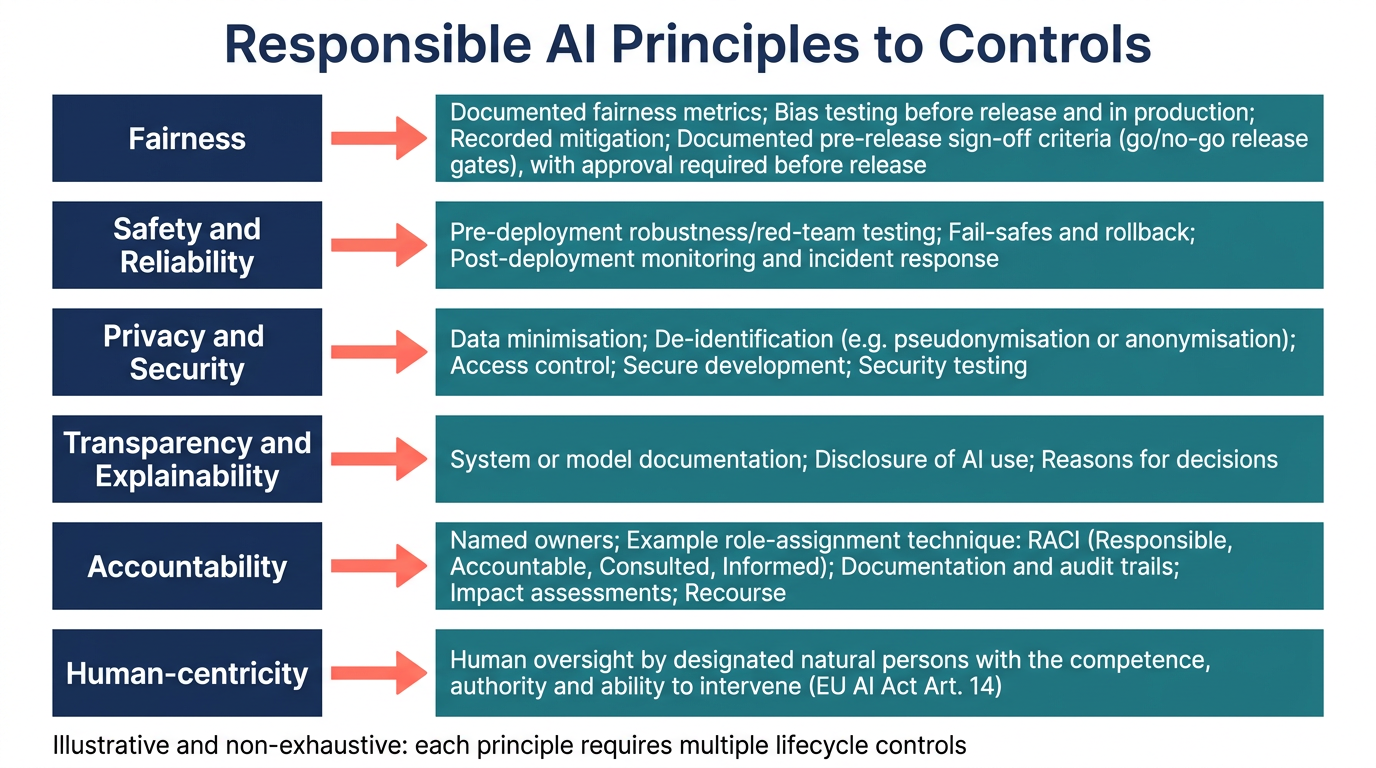
These principles do not stay abstract. Each one leads to a control. The next section shows how those controls become a governance program with risk appetite, roles, and checkpoints.
The concepts
fairness
Domain IFairness means the AI does not pick on some people because of who they are.
Fairness means the AI does not pick on some people because of who they are.
Think of it as A fair referee calls the same foul for both teams, even if one team has been winning for years.
Where the simple version breaks: The simple version ignores that past data can bake in old unfairness even when the AI never sees a protected label.
Precisely: Fairness requires checking whether AI treats people unjustly and addressing discrimination and harmful bias in its data, decisions, and use. The assessment must account for the setting and people's rights; a single statistical result cannot settle every fairness question [S5, Section 3.7][S6].
The problem: AI systems learn patterns from data that may contain historical discrimination, so they can reproduce or amplify unfair treatment.
What must be true
- Fairness requires examining treatment and outcomes for affected people and addressing harmful bias in context [S5, Section 3.7][S6].
- Protected characteristics include race, sex, age, disability, and similar grounds.
- Bias can enter through training data, feature selection, or model design.
- Fairness is not one metric; different definitions can conflict.
The assumption to question: A model is fair if it does not use a protected characteristic as an input.
Rebuilding it
- Identify who could experience unfair treatment in the intended use.
- Check whether the data adequately represents affected groups.
- Choose and document measures that reveal relevant differences in outcomes.
- Test for harmful bias, address disparities, and record the results.
- Monitor outcomes after deployment and revisit controls when the context changes [S5].
The principle of assessing and addressing unjust treatment, discrimination, and harmful bias in AI. Evaluation must consider affected people, their rights, and the context of use, not just an overall performance score [S5, Section 3.7][S6].
Traps
- Fairness means the model never uses a protected attribute as an input.. Correlated inputs can still produce discrimination. Illustrative: a recreation-booking model uses device type, which acts as a proxy for age in its user population.
- Fairness is a single statistical test applied once before deployment.. Fairness requires multiple metrics and ongoing monitoring because data and context change.
- Fairness only matters for hiring and lending.. Fairness applies to any decision that affects people, including healthcare, education, and public services.
Illustrative: a public recreation service tests its automated booking assistant with people using different communication methods. Higher error rates for people using speech aids lead the team to improve the training examples and retest before release.
- What is one way a model can be unfair without using a protected attribute directly?
- Why is a single fairness metric not enough?
safety
Domain ISafety means finding ways the AI could cause serious harm and avoiding or controlling risks that are not acceptable where it will be used.
Safety means finding ways the AI could cause serious harm and avoiding or controlling risks that are not acceptable where it will be used. Consider harm to health, safety, rights, property, and the environment [S5, Section 3.2].
Think of it as A safe car has brakes that work even when the road is wet, not just on a sunny test track.
Where the simple version breaks: Safety is not a promise of zero harm. The assessment must say which operating conditions it covers and what risks are unacceptable. Testing, fallback procedures, fail-safes, and monitoring are controls for those risks. Whether the system functions as intended and withstands errors belongs to validity, reliability, and robustness, which do not by themselves establish safety [S5, Sections 3.1 and 3.2].
Precisely: Safety is the avoidance of unacceptable harm, or management of its risk, under stated conditions of use. It covers health, safety, rights, property, and the environment, with testing, fallback procedures, fail-safes, and monitoring used as controls [S5, Section 3.2]. Intended performance and resilience to errors are assessed through validity, reliability, and robustness [S5, Section 3.1].
The problem: An AI system can complete its assigned task yet still create unacceptable harm. Teams must assess and control risks to health, safety, rights, property, or the environment under stated conditions of use [S5, Section 3.2].
What must be true
- Safety means avoiding unacceptable harm or managing its risk within stated conditions of use. It does not mean eliminating every possibility of harm [S5, Section 3.2].
- Safety applies to physical systems like robots and digital systems like content filters.
- Failures can come from unexpected inputs, distribution shift, or adversarial attacks. Distribution shift means that the data or conditions encountered in use differ from those used to develop or test the system. Changes in the input data over time are often called data drift, as discussed in the reliability card.
- Safety requires testing beyond normal conditions.
The assumption to question: A system that passes its training tests is safe.
Rebuilding it
- Identify potential harms to health, safety, rights, property, or the environment in the intended setting [S5, Section 3.2].
- Document operating limits and conditions that could cause failure.
- Test foreseeable failures, edge cases, and conditions outside normal operation.
- Define safe fallback states, fail-safes, and ways for authorized people to intervene [S5, Section 3.2 and MANAGE 2.3-2.4].
- Monitor safety signals and respond when risks exceed acceptable limits [S5].
The principle of avoiding unacceptable harm or managing its risk to health, safety, rights, property, or the environment under stated conditions. Correct or robust performance alone does not establish safety [S5, Sections 3.1 and 3.2].
Traps
- Safety only applies to physical robots and autonomous vehicles.. Digital systems can cause harm through wrong medical advice, biased content moderation, or financial errors.
- A system is safe if it performs well on its training data.. Training data does not cover all real-world conditions or adversarial inputs.
- Safety is the same as security.. Security protects against malicious actors; safety covers accidental failures and unintended behavior too.
Illustrative: a medical triage tool is tested on data outside its training set and includes a stop mechanism that returns control to a clinician when confidence drops.
- Why is testing on training data not enough for safety?
- Name one control that limits damage when an AI system fails.
reliability
Domain IReliability means the AI works the same way every time you need it.
Reliability means the AI works the same way every time you need it.
Think of it as A reliable bus shows up on time every day, not just on the first day of the month.
Where the simple version breaks: The simple version misses that 'the same way' can still be wrong if the world changes.
Precisely: Reliability is the ability to function as intended consistently over time under stated conditions. Validity concerns meeting intended-use requirements, while robustness concerns maintaining performance despite changes or errors in inputs and conditions [S5, Section 3.1].
The problem: An AI system must meet its intended-use requirements and function consistently under stated conditions, or users cannot depend on it [S5, Section 3.1].
What must be true
- Validity asks whether the system meets the requirements of its intended use. Reliability asks whether it continues to function as intended over time under stated conditions [S5, Section 3.1].
- Robustness concerns maintaining performance despite errors, unexpected inputs, or changes in operating conditions [S5, Section 3.1].
- Reliability is related to but distinct from safety.
- Reliability requires monitoring and maintenance.
The assumption to question: A model that works once will keep working.
Rebuilding it
- Define the performance and availability needed for the intended use.
- Test against those requirements under representative operating conditions.
- Monitor errors and changes in performance after deployment.
- Set thresholds for investigation, maintenance, and fallback operation.
- Keep records of evaluations and corrective actions [S5].
The ability of an AI system to function as intended consistently over time under stated conditions, distinct from validity and robustness as related performance characteristics [S5, Section 3.1].
Traps
- Reliability and safety are the same thing.. A system can be reliable but unsafe. Illustrative: a medical tool consistently produces the same incorrect diagnosis for a particular condition.
- Reliability is guaranteed at deployment.. Data drift means that the input data changes over time. It is a form of the distribution shift explained in the safety card. This shift, or changes in operating conditions, can degrade performance after launch.
- Reliability only concerns uptime and availability.. Reliability also concerns correctness and consistency of outputs, not just system availability.
Illustrative: a transit service's passenger-demand model performs well at launch but becomes less accurate after new routes open. Monitoring triggers a review and updated testing before the model is used to revise schedules.
- How is reliability different from safety?
- What causes an AI system to become less reliable after deployment?
privacy
Domain IPrivacy means AI must use information about people lawfully and fairly, whether or not it asked their permission.
Privacy means AI must use information about people lawfully and fairly, whether or not it asked their permission. It must respect the purposes for using that information and use only the personal data needed for those purposes [S9, Articles 5 and 6].
Think of it as Illustrative: a museum receives a visitor's contact details to follow up on feedback. Having those details does not give its AI tool free rein to reuse them for marketing.
Where the simple version breaks: Asking permission does not settle every privacy question. Consent is only one of several lawful bases under GDPR Article 6. Processing under other bases remains constrained by purpose limitation and data minimisation, just as processing based on consent does [S9, Articles 5 and 6].
Precisely: Privacy addresses the effects on people of AI collecting, using, sharing, or drawing inferences about their information [S5, Section 3.6]. Under the GDPR, teams must establish a lawful basis, process personal data fairly, respect purpose limits, and keep data to what is necessary. These duties apply whether consent or another Article 6 basis is used [S9, Articles 5 and 6].
The problem: AI can violate privacy through how it handles personal information, even without exposing someone's name. Lawful and fair processing is required whether or not permission was requested [S5, Section 3.6][S9, Articles 5 and 6].
What must be true
- Permission is not the test for every lawful use of personal information. GDPR Article 6 provides several lawful bases, including consent; purpose limitation and data minimisation apply whichever basis is used [S9, Articles 5 and 6].
- Personal data is information relating to an identified or identifiable individual.
- Privacy applies to training data and inference inputs.
- Individuals have rights to access, correct, and delete their data.
The assumption to question: Privacy only matters when the AI output reveals a person's name.
Rebuilding it
- Map personal data used in training and inference, define the processing purposes, and identify the applicable lawful basis. Do not assume consent is required for every use or that obtaining it removes other duties [S9, Articles 5 and 6].
- Identify controller and processor roles separately under GDPR Article 4(7) and 4(8): the controller determines the purposes and means of processing, while a processor processes personal data on the controller's behalf. Controller status does not automatically belong to the AI deployer [S9, Article 4(7)-(8)].
- Limit processing to data necessary for those purposes and apply appropriate safeguards [S9, Article 5(1)(c) and (f)].
- Provide procedures for handling applicable access, correction, and erasure rights.
- Document how the controller meets and demonstrates compliance with the GDPR principles [S9][S10].
The principle of protecting people from privacy risks arising from AI's handling of information about them. GDPR processing must be lawful and fair even when permission was not requested. Consent is one of several Article 6 bases, and every basis remains subject to purpose limitation and data minimisation [S5, Section 3.6][S9, Articles 5 and 6].
Traps
- Privacy only applies to data that directly names a person.. Personal data includes any information relating to an identifiable individual, such as location or device identifiers.
- Deidentification always eliminates privacy risk.. Removing names does not establish anonymity. GDPR Recital 26 requires considering the means reasonably likely to be used to identify someone [S9, Recital 26].
- Privacy is only a legal issue, not a technical one.. GDPR compliance includes data minimization and appropriate technical and organizational safeguards, not just legal documentation [S9, Articles 5(1)(c) and 25].
Illustrative academy scenario, using only fictional records and no real people, companies, or personal data: a museum visitor-feedback tool is configured to reuse contact details collected for feedback follow-up to send marketing messages. The academy team flags the change for purpose-limitation review and blocks the marketing export until the proposed reuse has been assessed [S9, Article 5(1)(b)].
- Give one example of personal data that does not include a name.
- Why is deidentification not a complete privacy solution?
security
Domain ISecurity means making it harder for someone to turn the AI against the people who rely on it.
Security means making it harder for someone to turn the AI against the people who rely on it.
Think of it as Illustrative: a museum gives a temporary cataloguer access to object descriptions, but not permission to unlock display cases. An AI assistant also needs limits on what it can access and do.
Where the simple version breaks: Permissions alone are not enough. Attackers may exploit software flaws or manipulate the information the AI receives.
Precisely: AI security addresses deliberate interference with system operation, data, and outputs. It requires defenses against attacks as well as ways to contain damage and recover [S5][S11].
The problem: An attacker may change what an AI system does, expose its information, or make it unavailable. A system that performs well in ordinary testing may still be vulnerable to deliberate interference [S5][S11].
What must be true
- Security must cover the service around the model, including connected tools, interfaces, and external components [S5][S11].
- An attack can target behavior rather than steal data. Manipulated inputs can cause a model to produce an incorrect result [S5].
- Generative AI can introduce additional attack paths when untrusted content influences instructions or connected tools [S11].
- Resilience includes limiting the effects of an attack and restoring operation after it [S5].
The assumption to question: A model is secure if nobody can download its training data.
Rebuilding it
- Specify which actions the AI may take and enforce those limits outside the model.
- Separate untrusted content from privileged instructions and restrict access to connected tools.
- Test attempts to manipulate outputs, expose restricted information, or disrupt service.
- Check whether external components create routes around these protections.
- Exercise incident response and recovery, then use the findings to improve defenses [S5][S11].
Protection against attacks that could expose information, manipulate AI behavior, or disrupt operation, supported by response and recovery measures [S5][S11].
Traps
- Security and privacy are interchangeable.. A system can prevent unauthorized access yet still process personal data for an unlawful purpose. Security protections do not replace privacy duties [S5][S9].
- Keeping the model's files secret prevents attacks.. An attacker may use a public interface or manipulated inputs without accessing model files [S5][S11].
- An ordinary network firewall addresses every AI attack.. An allowed request can still contain an attack. Illustrative: a museum's cataloguing assistant reads an uploaded document that tells it to send internal records elsewhere. Enforce connected-tool permissions and least privilege outside the model so that, even if the model follows the injected instruction, it cannot access or transmit resources beyond its authorized scope. Test those controls alongside network defenses rather than relying on the model to resist the instruction [S5][S11].
Illustrative: a museum evaluating an AI cataloguing component discovers that it sends submitted images to an unapproved external server. The team blocks integration and investigates the supplier's data-handling arrangements.
- How could an attacker change an AI system's behavior without stealing its data?
- Why should an AI assistant's tool permissions be enforced outside the model?
accountability
Domain IAccountability means each organization knows what it must do and can answer for whether it did it.
Accountability means each organization knows what it must do and can answer for whether it did it.
Think of it as A building designer and a building operator have different responsibilities. Naming the operator does not erase the designer's duties, and naming the designer does not erase the operator's.
Where the simple version breaks: The analogy does not determine legal duties. Those depend on the applicable law and the organization's actual role.
Precisely: Accountability allocates and documents duties across the AI lifecycle. For high-risk systems, EU AI Act Article 16 assigns providers design, conformity, and compliance duties, while Article 26 assigns deployers use-context, monitoring, and oversight duties [S8].
The problem: When an AI system causes harm, the relevant organizations must be answerable for their duties and provide routes to address the harm.
What must be true
- Accountability requires clear duties, evidence that those duties are met, and routes for escalation and recourse [S5].
- The EU AI Act, Regulation (EU) 2024/1689, defines provider and deployer roles in Article 3. For high-risk AI systems, Article 16 assigns provider duties, including ensuring the applicable conformity assessment is carried out. Conformity assessment is the procedure for demonstrating that a high-risk system meets the Act's applicable requirements; the route depends on the system and applicable rules. Article 25 identifies circumstances in which another party takes on provider duties [S8].
- Deployers bear use-context, monitoring, and oversight duties under EU AI Act Article 26 [S8].
- Under the GDPR, accountability for compliance with the data protection principles belongs to the controller, not automatically to the AI deployer [S9].
The assumption to question: One role, whether provider or deployer, always owns all accountability.
Rebuilding it
- Identify each organization's actual role and the obligations that apply to it.
- Map provider duties for design, conformity, and compliance separately from deployer duties for use-context, monitoring, and oversight [S8].
- Record responsibilities, decision authority, and escalation paths in lifecycle policies and procedures [S5, GOVERN 2.1][S12, Clauses 5.3 and 8.1].
- Define operational criteria and keep records showing that processes followed them. Address nonconformities, assess causes, take appropriate corrective action, and check effectiveness [S12, Clauses 8.1 and 10.2].
- Provide routes for reporting harm, challenging decisions, and coordinating a response without treating contracts as a substitute for statutory duties [S5][S8].
The principle of allocating and documenting responsibility for AI system design, deployment, and monitoring, with evidence of compliance and routes for recourse [S5][S8].
Traps
- Either the provider or the deployer must ultimately own all accountability.. Duties are role-based. For high-risk AI systems, Article 16 places design, conformity, and compliance duties on providers, while Article 26 places use-context, monitoring, and oversight duties on deployers [S8].
- Accountability means having a named person, nothing more.. It also requires documented responsibilities, evidence of evaluation and monitoring, escalation procedures, and responses to identified problems [S5][S12].
- A vendor contract transfers all statutory duties, and the AI deployer is always the GDPR-accountable party.. Contracts do not erase duties attached to provider or deployer roles under the AI Act. GDPR accountability for the data protection principles belongs to the controller, whose role must be assessed separately [S8][S9].
For high-risk AI systems, EU AI Act Article 16 places design, conformity, and compliance duties on providers. Article 26 places use-context, monitoring, and oversight duties on deployers, including assigning human oversight to people with the necessary competence, training, and authority [S8].
- How do provider duties under Article 16 differ from deployer duties under Article 26?
- What is one mechanism that provides recourse to an affected person?
human-centricity
Domain IHuman-centricity asks whether the AI works for people, including those who have little say in its use.
Human-centricity asks whether the AI works for people, including those who have little say in its use.
Think of it as Illustrative: a benefits office does not judge its support tool only by how quickly it clears cases. It also checks whether applicants can correct evidence and get a meaningful review.
Where the simple version breaks: A review process alone does not settle whether the use is appropriate. Some uses may still interfere with rights or dignity.
Precisely: Human-centricity makes respect for human rights, dignity, and agency a condition of AI design and use. Participation, impact assessment, and context-appropriate oversight help put that commitment into practice [S7].
The problem: An AI project can meet its performance target while leaving affected people with less choice, less control, or no practical way to question what happens to them [S7].
What must be true
- Human rights and dignity set boundaries for AI use, even when automation offers efficiency gains [S7].
- The people affected by a system include those who never use its interface [S7].
- Participation and impact assessment help reveal effects that technical performance measures miss [S7].
- Human oversight must fit the context and preserve human responsibility; it is not satisfied by adding an approval button [S7].
The assumption to question: If a system is accurate and convenient for its users, it must be good for everyone it affects.
Rebuilding it
- Ask whether AI is an appropriate way to address the need, including whether a less intrusive alternative would work.
- Invite affected people to identify barriers, concerns, and consequences that the project team may overlook.
- Assess impacts on rights, dignity, and people's ability to make choices.
- Give responsible reviewers enough information, time, and authority to intervene where oversight is needed.
- Review actual effects after deployment and change or stop uses that cannot be justified [S7].
An approach to AI that places human rights, dignity, and agency at the center of decisions about whether and how a system is used [S7].
Traps
- Human-centricity requires a person to approve every output.. Oversight should fit the context and consequences. A human approval step is neither necessary for every low-risk output nor sufficient to make a harmful use acceptable [S7].
- A good user interface proves that a system is human-centered.. The system may affect people who do not use it. Their rights and interests also matter [S7].
- High accuracy removes the need to assess human impacts.. Accuracy does not show whether a use respects dignity, preserves agency, or creates unjustified interference with rights [S7].
UNESCO's Recommendation on the Ethics of AI places human rights and dignity at the center of AI ethics and calls for impact assessment and human oversight [S7].
- Who might be affected by an AI system without being one of its users?
- Why might a highly accurate AI system still be inappropriate to use?
explainable AI
Domain IExplainable AI helps people see enough of the reasons behind a result to check and question it.
Explainable AI helps people see enough of the reasons behind a result to check and question it.
Think of it as Illustrative: a water-allocation notice shows the usage records and drought rule used in the calculation, instead of only saying that the allocation was reduced.
Where the simple version breaks: Complex models may not offer a complete step-by-step account. A helpful explanation may cover only part of their behavior and must not claim more than it shows.
Precisely: Explainable AI uses methods that make aspects of system behavior and outputs understandable to a particular audience. Explanations should be evaluated for usefulness, accuracy, and limitations [S5].
The problem: A person may receive an AI-assisted result without enough information to check it, use it appropriately, or challenge an error [S5][S6].
What must be true
- Different audiences need different information: an affected person, an operator, and an evaluator do not ask the same questions [S5].
- Useful explanations connect a result to relevant evidence or aspects of system behavior, rather than merely repeating the result [S5].
- Information about limitations helps people judge when not to rely on a system [S5][S6].
- An explanation can be incomplete or approximate. Its limits should be communicated rather than hidden [S5].
The assumption to question: A fluent account of why an AI produced an answer proves that the account is correct.
Rebuilding it
- Choose a concrete question the audience needs answered, such as which records influenced an allocation.
- Select an explanation method that can address that question for the system in use.
- Check the account against evidence about the system's behavior, including cases where the method may mislead.
- Test whether the intended audience understands the account and its limits.
- Provide a way to question the result and revisit explanations when the system or its use changes [S5][S6].
Methods and practices that help a relevant audience understand AI behavior or outputs, with clear limits on what the explanation establishes [S5].
Traps
- A convincing explanation proves that the output is correct.. An explanation can clarify an incorrect result or misrepresent how it arose. The output and explanation both need evaluation [S5].
- Every audience should receive the same technical explanation.. Information must fit its audience and purpose. A detailed technical account may not help an affected person understand or challenge a result [S5][S6].
- Publishing source code is enough to explain a decision.. Code alone may not reveal which evidence mattered in a particular case or give an affected person usable information for questioning the outcome [S5][S6].
Illustrative: a water-allocation service provides an understandable account of the usage records and drought restrictions behind a reduced irrigation allocation. The recipient can inspect those records and request correction of an error.
- What would an affected person need to understand to challenge an AI-assisted result?
- Why should an explanation be tested rather than accepted because it sounds plausible?